Current Issue

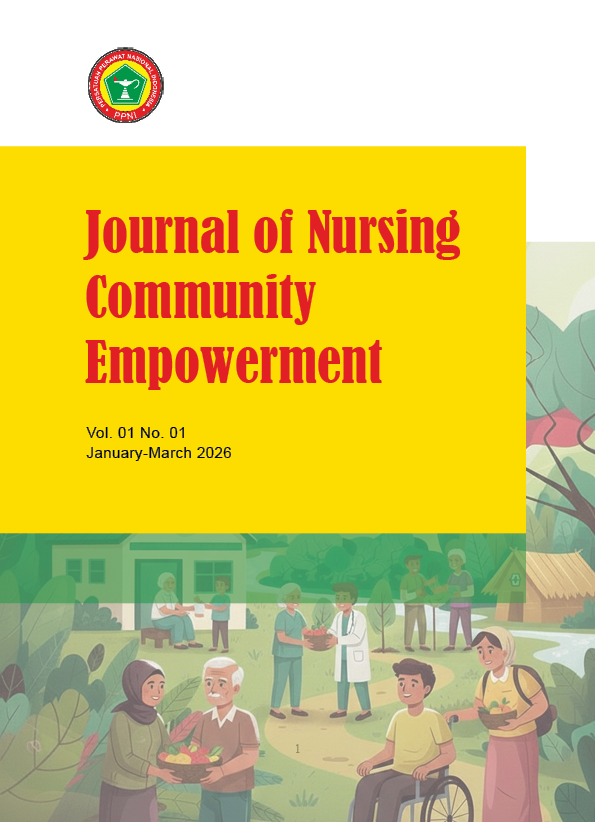
Vol. 1 No. 1 (2026): Journal of Nursing Community Empowerment
					View Vol. 1 No. 1 (2026): Journal of Nursing Community Empowerment

Puji syukur ke hadirat Tuhan Yang Maha Esa, edisi perdana Jurnal Keperawatan dalam Pengabdian kepada Masyarakat hadir sebagai sarana publikasi ilmiah yang menyoroti berbagai kegiatan pengabdian di bidang keperawatan dan kesehatan. Karya-karya yang dimuat dalam edisi ini mencerminkan komitmen tenaga kesehatan dan akademisi dalam memberikan kontribusi nyata bagi masyarakat melalui inovasi, edukasi, serta pemberdayaan. Berbagai topik yang diangkat meliputi peningkatan pengetahuan perawat dalam mendeteksi dini maserasi pada luka kaki diabetik dengan teknologi FLIR One smartphone thermography, edukasi pencegahan hipertensi melalui penyuluhan dan skrining tekanan darah, pemberdayaan kader posyandu lansia melalui pelatihan pemeriksaan kesehatan dasar, edukasi gizi seimbang bagi anak sekolah dasar, hingga pelatihan pertolongan pertama untuk meningkatkan keterampilan masyarakat dalam menghadapi keadaan darurat.

Melalui publikasi ini, diharapkan setiap artikel tidak hanya menjadi dokumentasi kegiatan pengabdian, tetapi juga menjadi referensi praktis yang dapat diaplikasikan oleh tenaga kesehatan, akademisi, maupun masyarakat luas. Kehadiran jurnal ini diharapkan mampu memperkuat peran pengabdian kepada masyarakat sebagai bagian integral dari pengembangan ilmu keperawatan, sekaligus menjadi inspirasi bagi lahirnya program-program berkelanjutan yang berorientasi pada peningkatan derajat kesehatan masyarakat.


Published: 2026-03-27
View All Issues

Journal of Nursing Community Empowerment (JNCE) is a multidisciplinary, peer-reviewed, open-access journal that disseminates the outcomes of community development programs to academics, society, nursing, and other health providers.  The journal distinguishes itself by prioritizing publications that translate research findings and expertise into practical solutions for community challenges.
Aligned with its mission, Indonesian National Nursing Empowerment Journal supports the achievement of the Sustainable Development Goals (SDGs) by bridging scientific knowledge and real societal impact. As a publication of an Indonesian educational institution, the journal's clinical setting, and the community, it also reflects Indonesia’s policy requiring academicians to publish the results of their community engagement activities.

Aim:
Journal of Nursing Community Empowerment (JNCE) is a multidisciplinary, peer-reviewed, open-access journal that focuses on sharing the achievements of community development initiatives, particularly through the application of research findings and professional expertise. The journal seeks to publish articles that offer innovative insights and encourage similar initiatives in other contexts. It also serves as a platform to support the required publication and dissemination of community engagement outcomes by academicians, nurses, and other health providers in accordance with Indonesian government regulations.

Scope:
Journal of Nursing Community Empowerment (JNCE) accepts articles that present best practices derived from applying expertise or implementing research findings in community development programs. The journal welcomes contributions across various domains, including applied science and technology solutions, socio-economic advancement, public health and well-being, as well as broader social and community development initiatives

Peer Review Process

All manuscripts submitted to JNCE undergo an initial editorial screening followed by a double-blind peer review process. Manuscripts that do not meet the journal’s criteria will be rejected at the preliminary stage. Those aligned with JNCE’s focus and scope are forwarded to at least two reviewers, though in some cases, more may be involved. Based on the reviewers’ evaluations, a manuscript may be accepted without revision, accepted with revisions, or rejected.
Manuscripts requiring revision will be returned to the authors for improvement in accordance with the reviewers’ comments. Rejected manuscripts are also returned to the authors, who may resubmit them provided all revisions comply with the journal’s guidelines and procedures.
The Editorial Team reserves the right to edit manuscripts and manage all aspects related to publication in line with the journal’s policies. After revisions are completed and approved by the reviewers, the manuscript proceeds to the final stages, including layout and publication.

Archiving

This journal is permanently archived to ensure long-term data preservation and security through the use of the LOCKSS (Lots of Copies Keep Stuff Safe) system.

Publication Frequency

JNCE is published every 4 months (March, July, November)

Open Access Policy

JNCE is a fully open-access journal, providing free access to all readers. Users are permitted to read, download, share, print, reproduce, and search the journal’s articles without any restrictions

Publication Ethics and Malpractice Statement

JNCE upholds a strict Code of Ethics for Scientific Publications in all its published works. This code is grounded in three core principles: neutrality (ensuring the absence of conflicts of interest in publication management), fairness (granting authorship only to those who rightfully qualify), and integrity (preventing duplication, fabrication, falsification, and plagiarism). The journal adheres to the ethical standards established by the Committee on Publication Ethics (COPE). Articles involving human participants must comply with the Declaration of Helsinki, while studies involving animals must follow the International Guiding Principles for Biomedical Research issued by the Council for International Organizations of Medical Sciences (CIOMS).
JNCE is dedicated to maintaining high ethical standards in publication. Any article that fails to meet these standards will be withdrawn. Suspected cases of plagiarism or duplicate publication will be reported to the appropriate authorities.
The following outlines the ethical responsibilities that must be observed by JNCE authors, editorial board members, and reviewers.

Editorial Policy

Writer:

  • Ensure that the manuscript/manuscript submitted is an original article, free from fabrication, falsification, plagiarism, duplication, fragmentation/salami, and copyright infringement of data/content.
  • Ensure that the manuscript has not been published elsewhere or is not in the process of being assessed in another journal, and during the assessment process by JNCE, it will not be withdrawn and sent to another journal for assessment.
  • Willing to improve the manuscript/manuscript that has been assessed and not withdraw it unilaterally without notifying the editor of JNCE, especially if the manuscript is in the process of review.
  • Inform INCE that the manuscript/manuscript sent does not contain unlawful, defamatory, or other statements and does not contain material that violates the personal rights or property rights of any person or other entity.
  • Informing JNCE that the manuscript submitted is the contribution of the entire writing team, does not involve honorary authors or ghost authors.
  • Write a thank you note to those who helped with the process of research and publication of manuscripts/manuscripts.
  • Declare authorship approval, which states that the writing team recognizes authorship related to public responsibility and is responsible for the overall content stated in the manuscript/manuscript.
  • Submit articles through the JNCE website.

Editorial Board:

  • Ensure double blind peer-review on manuscripts sent by authors is carried out fairly and proportionately
  • Disclose if there is a conflict of interest. Ensure that all information related to the submitted manuscript is kept confidential before publication.
  • Evaluate manuscripts only for their intellectual content regardless of the author's ethnicity, beliefs, politics, racial, religious, and institutional affiliations.
  • The Editor-in-Chief coordinates the division of roles and responsibilities of the JNCE editorial board team.
  • Editors can communicate with reviewers to make a final decision.

Reviewer:

  • Evaluate manuscripts based on content without regard to the author's ethnic origin, gender, sexual orientation, nationality, religious beliefs, or political choices.
  • Ensure that all information related to the submitted manuscript is kept confidential and report to the Editor-in-Chief if aware of copyright infringement and plagiarism on the author's side.
  • Evaluate the submitted manuscript objectively and clearly present their opinions about the work in a clear way in the form of reviews and fill in the form of JNCE article review results.
  • Maintain information related to secret manuscripts.
  • Inform the Editor-in-Chief and withdraw himself from the review process if he feels he is not qualified to review the research reported in the manuscript.

Disclaimer

Opinions that appear in articles published on JNCE do not reflect the views of the editorial board or of the publisher.

Publication Charges

JNCE is an open-access journal. For every manuscript accepted for publication in JNCE, the fee was IDR 250.000 for authors who were active members of INNA (as evidenced by active NIRA) and IDR 500.000 for general authors. 

Advertising Policy

Ads are not allowed to appear in the printed or online versions of the script.